Highlights:
– Over $1 billion is expected to flow into the Hang Seng Tech Index with the inclusion of two AI firms, Knowledge Atlas and MiniMax.
– Despite recent struggles, the index is set to gain traction as more investors turn to AI technologies.
– Analysts predict significant revenue growth for these Chinese AI companies, indicating a reshaping of Hong Kong’s equity market.
Changing Dynamics in Hong Kong’s Tech Landscape
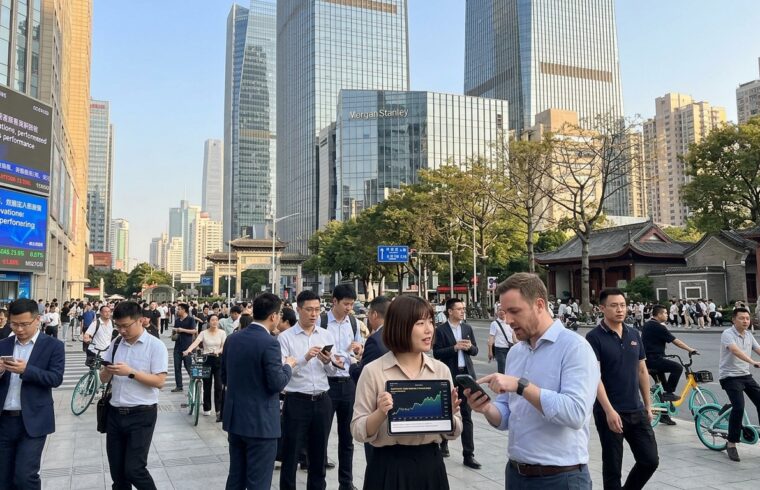
The financial landscape of Hong Kong is poised for a transformative shift as the Hang Seng Tech Index prepares to welcome two burgeoning players in the artificial intelligence sector. Morgan Stanley has recently announced the anticipated inclusion of Knowledge Atlas Technology and MiniMax, two companies that have made waves since their public debuts in January 2023. This move is expected to unleash an influx of capital ranging from $1.25 billion to $1.75 billion into the index, thereby rekindling interest in a market that has seen a decline of over 11% this year.
The significance of this addition cannot be overstated. As the world increasingly gravitates towards AI technologies, Hong Kong’s tech index has struggled, leaving investors uncertain about future growth. With the integration of these innovative AI companies, there is new hope that the Hang Seng Tech Index may not only recover but flourish, aligning itself with global trends and capitalizing on the booming demand for AI solutions.
Investors Look to AI as a Growth Engine
At the core of this anticipated revitalization are Knowledge Atlas and MiniMax, both of which have demonstrated remarkable growth trajectories in the past few months. Knowledge Atlas, known for its coding capabilities through its Zhipu AI model, and MiniMax, recognized for its diverse applications in AI such as text and audio generation, exemplify the potential of Chinese technological advancements. The significant uptick in their stock prices, now forecasted to reach as high as 990 HKD and 1,100 HKD respectively, underscores the immense enthusiasm surrounding these firms.
Morgan Stanley’s analysts have noted that the landscape of AI pricing is shifting as well, with costs associated with Chinese AI models rising from 5% to 17% of their U.S. counterparts in just a year. This upward trend suggests that these AI entities are not only becoming more competitive but are also carving out a space in a market that has predominantly favored U.S. innovations. The predicted revenue of over $1 billion for each of these firms this year further illustrates the untapped potential that exists within this niche.
Repercussions for Hong Kong’s Market and Beyond
As the influence of AI companies like Knowledge Atlas and MiniMax grows, their presence in the Hang Seng Tech Index signifies a broader shift in market dynamics. Analysts at Morgan Stanley assert that AI-driven entities will become a substantial force in reshaping Hong Kong’s equity markets, not only by altering index composition but also by boosting performance and liquidity. Strong regulatory support complements this trend, with tech accounting for a significant portion of recent IPOs, thus solidifying AI’s standing as a lasting facet of Hong Kong’s economic landscape.
While Hong Kong’s tech giants, including Tencent and Alibaba, have faced declines, the emergence of AI-focused firms brings a fresh perspective to the investment community. As Alibaba emerges as a favored choice among internet stocks, driven by its commitment to integrating AI throughout its operations, the stage is set for a major pivot in investment strategies. The vitality of AI in the region points to a promising horizon, but it also raises questions about sustainability and competition in a rapidly evolving tech ecosystem.
In conclusion, the inclusion of Knowledge Atlas and MiniMax in the Hang Seng Tech Index could signify a turning point for Hong Kong’s tech market. As interest in AI grows and more capital flows into these sectors, how will traditional tech giants adapt? What implications will this have for investor sentiment moving forward? And can we expect more rapid innovation from newly public AI companies in the near future?
Editorial content by Sage Anderson